Overview
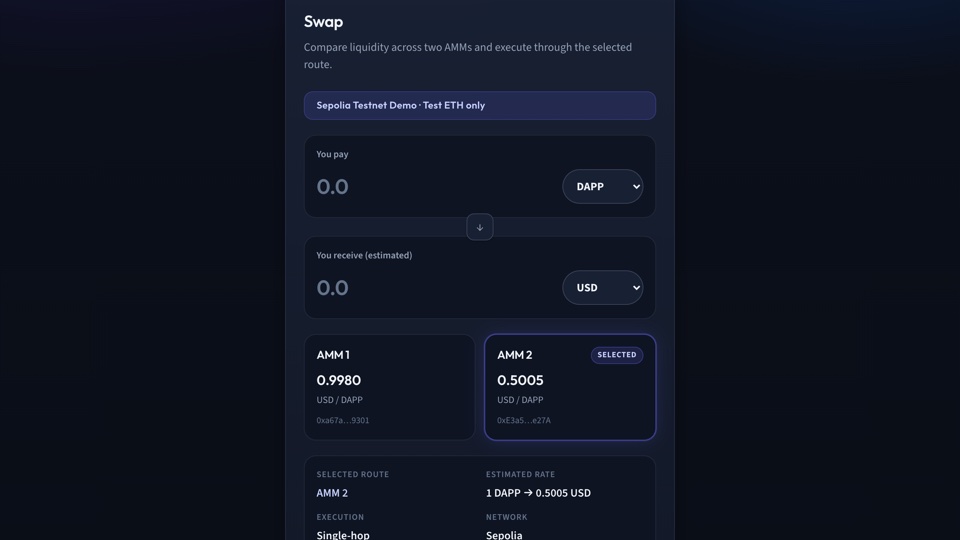
This project implements two independent AMM contracts, ERC-20-style demo tokens (DAPP / USD), an on-chain Aggregator for quote comparison across those pools, and a React dApp that connects a wallet, reads quotes, and submits swaps and liquidity transactions through Ethers.js.
Aggregation here means single-hop comparison across two AMMs — not multi-hop routing, split routing, or a production DEX aggregator graph.
Engineering Problem
Independent AMM pools can produce different swap outcomes for the same token pair because reserve balances and liquidity depth differ. Manually checking each pool is error-prone and slow.
The engineering goal is to query multiple liquidity sources, compare expected pricing, and direct a single-hop swap toward the route selected by the comparison logic — while keeping market logic on-chain and wallet interaction in the application layer.
My Role
DeFi Protocol Engineering · Full-Stack dApp
I implemented and integrated the public project end-to-end: Solidity contracts (Token, AMM, Aggregator), Hardhat deployment configuration, React application surfaces for swap/deposit/withdraw, MetaMask wallet connection, and Ethers.js contract reads/writes.
This is an engineering demonstration project with public source and demo — not a claim of production DEX operations or production liquidity.
AMM Mechanics
Implemented
Each AMM contract tracks token-pair reserves and prices swaps from the current reserve ratio:
amountOut = amountIn × reserveOut / reserveIn
This is simplified reserve-ratio pricing suitable for demonstrating liquidity-driven quote differences across independent pools. It is not a Uniswap-style invariant-preserving constant-product curve with (reserveIn + amountIn) in the denominator, and the contracts do not implement a swap fee.
- Independent AMM1 and AMM2 contracts with shared Token pair support Implemented
- Reserve reads via getReserves / getPrice Implemented
- Swap fee curve / Uniswap v2 invariant pricing Not Supported
Aggregation / Routing Logic
Implemented
The Aggregator contract is constructed with exactly two AMM instances (AMM1, AMM2). getPriceData is a view call that queries each AMM’s getPrice, skips pools that revert (no liquidity), and returns the selected lower-price comparison result with the corresponding AMM name.
The Aggregator contract provides on-chain quote comparison across AMM1 and AMM2. The frontend uses the returned comparison to select that AMM, approves it, and executes the swap directly against the selected AMM contract. Quote comparison therefore exists as an on-chain view (getPriceData) while live execution is a selected-AMM swap after allowance approval — not Aggregator.performSwap as the verified frontend path.
- Two-AMM quote comparison Implemented
- Single-hop execution on one selected AMM Implemented
- Multi-hop routing · split routing · path graph optimization Not Supported
Contract Architecture
Deployment wires demo tokens, two AMM pools, and one Aggregator that references both AMMs.
- AMM1 (AMM.sol)
- AMM2 (AMM.sol)
- Token.sol · DAPP
- Token.sol · USD
Swap Execution Flow
Read-only quote calls are separated from state-changing transactions.
Liquidity / LP Logic
Implemented · Simplified
AMM.addLiquidity and AMM.removeLiquidity transfer tokens and update shared reserve/liquidity mappings for a token pair. The dApp exposes Deposit and Withdraw tabs for these flows.
Liquidity accounting is simplified: the current contracts do not mint ERC-20 LP share tokens or implement production-grade per-provider share math. Treat this as an engineering demonstration of reserve updates, not a production LP system.
Frontend + Wallet Integration
Implemented
The React application loads network-specific addresses from config (Hardhat 31337 and Sepolia 11155111), connects MetaMask via Ethers.js, and uses contract ABIs for Token / AMM / Aggregator reads and writes. Core surfaces include Swap, Deposit, Withdraw, Charts, network selection, and wallet connect.
- React application
- Ethers.js provider / signer
- MetaMask connection
- ABI-backed contract calls
- Quote / price reads
- Approve + swap transactions
- Balance refresh after txs
Security & Reliability
Supported contract-level checks include Solidity 0.8 arithmetic safety, token transfer/allowance validation, zero-address rejection on token transfer/approve paths, and require-guards when a pair has no liquidity.
- Solidity ^0.8 checked arithmetic
- ERC-20-style allowance + transferFrom for swaps/liquidity
- No-liquidity require on swap / getPrice
- Zero-address checks on Token transfer / approve
Slippage limits, deadlines, reentrancy guards, and swap fees are not implemented. This project demonstrates AMM and routing mechanics and should not be interpreted as a production-hardened DEX.
Engineering Decisions
- Two independent AMM contracts
- Separate reserve states create meaningful quote differences for the same token pair — the prerequisite for aggregation.
- Reserve-ratio swap pricing
- Deterministic, easy-to-reason pricing from current reserves; chosen to demonstrate liquidity-driven execution differences rather than full Uniswap invariant mechanics.
- On-chain Aggregator quotes + selected-AMM execution
- getPriceData centralizes comparison on-chain; the dApp then approves and swaps on the Aggregator-selected AMM so user allowances and transfers align with the selected pool.
- Solidity + Hardhat
- Core market logic and deployment tooling for local Hardhat and Sepolia-configured networks.
- React + Ethers.js
- Bridges wallet signing, quote reads, approvals, and state-changing transactions into a usable swap workflow.
What I Personally Built
- Token, AMM, and Aggregator Solidity contracts Smart Contracts · Implemented
- Two-AMM price comparison and single-hop selection logic Routing Logic · Implemented
- React swap / deposit / withdraw application surfaces Frontend · Implemented
- MetaMask connection, approvals, and Ethers.js contract calls Wallet Integration · Implemented
- Hardhat deploy scripts and network address config (local + Sepolia) Deployment · Implemented
- Hardhat test suite present in repo (interface drift vs current AMM API) Testing · Partial
Technology
- Solidity
- Ethereum / EVM
- Hardhat
- Ethers.js
- React
- JavaScript
- Node.js
Current Status
Completed Engineering Project · Public Source · Sepolia Demo · Verified
Available
- Public GitHub repository
- Public Vercel demo (Sepolia)
- Local Hardhat + Sepolia address configuration
- Verified Sepolia quote comparison + selected-AMM swap
Scope
- Educational / engineering implementation
- Two-AMM single-hop aggregation
- Not a production DEX, mainnet deployment, or production users